
Corporate IT, Internal Audit & Risk Management
Executive Takeaways & Strategic Impact
- Non-Human Identity (NHI) Management: Every autonomous agent is provisioned as an isolated service principal with distinct cryptographic tokens and role bounds.
- Transaction Value Ceilings: Hard execution circuit breakers prevent agents from creating financial or stock commitments exceeding configured monetary thresholds.
- Cryptographic Flight Recorder: All agent decisions, inputs, context tokens, and database write operations are stored in append-only audit tables.
- DPDP Act & ISO 27001 Compliance: Meets strict regulatory mandates for automated data processing, employee privacy, and financial auditability.
1. The Hidden Risks of Ungoverned Autonomous AI in Core Systems
As enterprises embrace autonomous AI agents to automate inventory replenishment, draft customer invoices, and negotiate procurement, Chief Information Security Officers (CISOs) and audit partners face new vulnerabilities. What happens when an LLM agent suffers hallucination and issues a Purchase Order for ₹50 Lakhs of unwanted materials? What happens when a prompt injection attack tricks an agent into disclosing customer pricing matrices?
Treating an AI agent as a regular super-user (admin) or sharing API keys across multiple scripts is an invitation to regulatory penalties, data leaks, and balance sheet disaster. Modern cloud ERP demands rigorous Non-Human Identity (NHI) governance.
2. The 4 Layers of Enterprise AI Guardrails
At Arihant AI, every autonomous system operates inside a four-tier defense boundary:
Layer 1: Identity & Scope
Dedicated service accounts with zero interactive login capability, restricted strictly to designated Odoo models.
Layer 2: Monetary Ceilings
Hard transaction caps (e.g. ₹50,000). Any transaction exceeding limits requires two-factor human authorization.
Layer 3: Behavioral Circuit Breakers
Automated kill switches halting agents if API call rates or error frequencies spike beyond normal standard deviations.
Layer 4: Immutable Flight Recorder
Cryptographically hashed, append-only logs capturing the prompt, context snapshot, reasoning output, and exact ORM write.
3. AI Safety Governance & Autonomous Action Flight Recorder
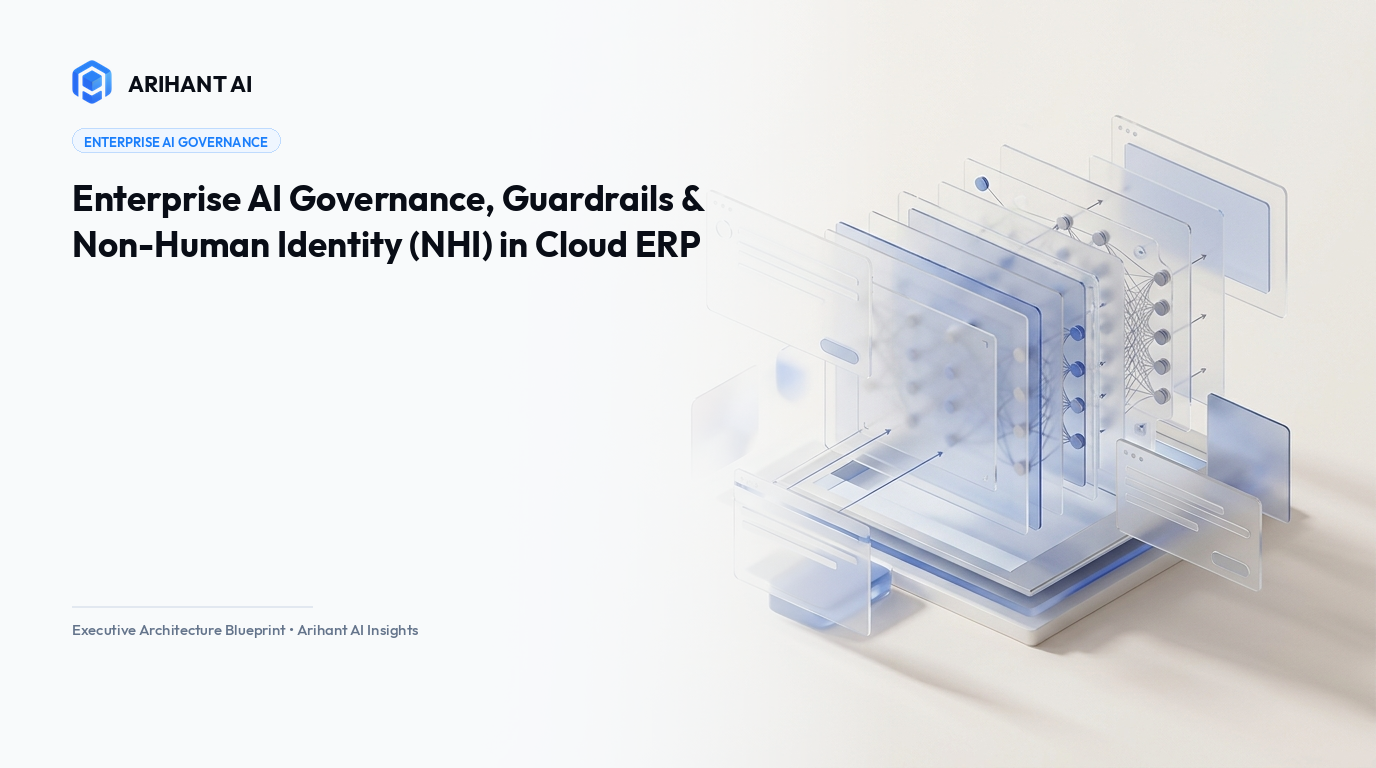
The AI governance architecture enforces hard transaction authorization ceilings, role-based tool restrictions, and cryptographic audit logging for all autonomous agents operating on enterprise data.
4. DPDP Act Compliance & Data Subject Privacy
Under India's Digital Personal Data Protection (DPDP) Act 2023/2025, autonomous agents must adhere to purpose limitation and data minimization. Agents processing vendor invoices or customer challans are architecturally prevented from retaining raw Aadhaar, PAN, or personal banking information in secondary prompt caches.
5. Implementation & Internal Audit Assurance
Establishing an AI governance framework takes 2 weeks. It equips leadership teams with peace of mind: reaping the full speed and efficiency of autonomous ERP while maintaining 100% statutory compliance and boardroom auditability.
Evaluate This Architecture for Your Enterprise
Schedule an architectural feasibility assessment with Lead Architect Jay Shah. On-site audits available across Gujarat manufacturing corridors and Dev Aurum, Prahlad Nagar, Ahmedabad.